
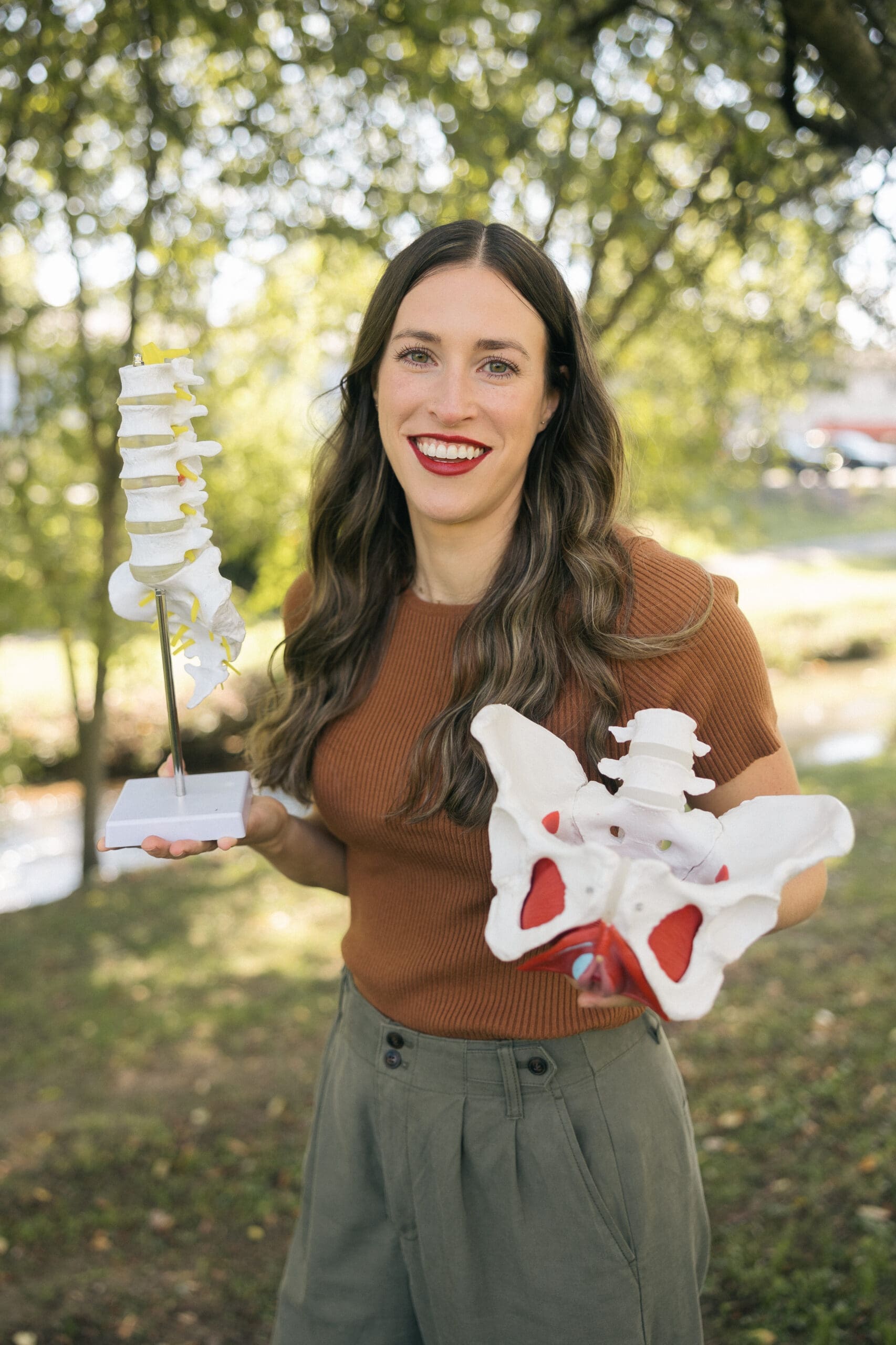
By Dr. Katie Spruell, PT, DPT, CSCS, PCES | Amplify Physio | Maryville, TN
If you’ve been diagnosed with pelvic organ prolapse — or you suspect you might have it — there’s a good chance someone has told you to take it easy. Maybe your medical provider said to avoid heavy lifting. Maybe you Googled it and came away more confused than when you started. Maybe you’ve just quietly stopped doing the things you love because you’re not sure what’s safe anymore.
Here’s what I want you to know: in most cases, not only can you exercise with pelvic organ prolapse — you probably should.
What Is Pelvic Organ Prolapse?
Pelvic organ prolapse (POP) happens when the muscles and connective tissue that support your pelvic organs — your bladder, uterus, or rectum — weaken, causing one or more of those organs to descend into or toward the vaginal canal. It’s more common than most people realize. Research estimates that up to 50% of women who have given birth have some degree of prolapse, though many experience few or no symptoms.
Symptoms can include:
- A feeling of heaviness or pressure in the pelvis
- A sensation of something bulging or falling out
- Low back pain or pelvic discomfort
- Leaking urine, especially with activity
- Difficulty with bowel movements
If any of that sounds familiar, you’re not alone — and you’re not out of options.
If you’re struggling with symptoms like heaviness, leaking, or pressure during exercise, learn more about our pelvic floor physical therapy services in Maryville, TN.
The Problem With “Just Rest and Avoid Impact”
The most common advice women receive after a prolapse diagnosis is to stop high-impact activity and avoid heavy lifting. And while there is a time and place for modifying load, this advice often goes too far — leaving women sedentary, fearful of movement, and convinced that their body is fragile.
That fear has real consequences. Avoiding movement entirely leads to deconditioning, muscle loss, weight gain, and worsening pelvic floor dysfunction over time. It also takes a serious toll on mental health, confidence, and quality of life.
I see this in my clinic regularly. Women come in having already spent weeks — sometimes months — being told to do less, only to find that doing less hasn’t helped at all. One patient came to me after six weeks of treatment at another clinic with no meaningful improvement. She went back to her OBGYN and asked the question that so many women are afraid to ask out loud: Is this as good as it’s going to get?
Her doctor said yes.
She came to us anyway.
Today she strength trains. She walks an hour and a half a day. She hikes. She does everything she had written off as a thing of the past — and she does it without symptoms.
So What Does the Research Actually Say?
Research published in The Lancet found that women who received pelvic floor muscle training reported significantly fewer prolapse symptoms than those in a control group, both at six months and at twelve months after treatment. The Lancet
A systematic review of 18 randomized controlled trials found improvements in symptoms associated with prolapse, in pelvic floor function, and in quality of life in women who completed a pelvic floor muscle training protocol. nih
The key word in all of this research is progressive. Not aggressive. Not avoidant. Progressive — meaning you start where you are, and you build from there.
The Real Answer: Start Where You Are
This is the principle I come back to with every single patient: you don’t need to do the perfect exercise. You need to do the exercise that’s available to you right now, in the body you have today.
If you can get in and out of a chair without symptoms — that is a squat. A sit-to-stand is a squat. And if that’s your current range of motion without prolapse symptoms, that is your entry point. Not a consolation prize. A legitimate, evidence-based starting point.
From there, you build:
- Sit-to-stands before weighted squats
- Walking before running
- Step-ups before jumping
- Bodyweight before loaded movement
Every rep you complete in a pain-free, symptom-free range is teaching your pelvic floor, your nervous system, and your supporting muscles that they are safe to work. That safety is what creates the capacity to do more over time.
What to Watch For
Exercising with prolapse doesn’t mean ignoring your body. There are signs that you need to pull back and reassess:
- Increased pelvic pressure or heaviness during or after exercise
- A bulging sensation that wasn’t there before
- Leaking that worsens with a particular movement
- Pelvic pain during activity
These aren’t reasons to stop moving altogether — they’re information. They tell you that the load exceeded your current capacity, and that you need to back up and build from a different starting point. That’s exactly what we help you figure out.
What About High-Impact Exercise — Running, Jumping, HIIT?
The goal for most of my patients isn’t to avoid these things forever. It’s to build the foundation that makes them possible without symptoms.
Running, jumping, and high-intensity exercise place significant demand on the pelvic floor. If you jump straight into those activities without the underlying strength to support them, symptoms increase. But if you build progressively — strength first, then impact — most women can return to the activities they love.
The timeline is different for everyone. But the path is the same: meet your body where it is, and give it what it needs to adapt.
Pelvic Floor PT in Maryville, TN and the Surrounding Area
If you’re in Maryville, Alcoa, Louisville, or anywhere in Blount County or the greater Knoxville area, and you’ve been told that prolapse means you have to give up the activities you love — I’d encourage you to get a second opinion.
At Amplify, we take a whole-body approach to pelvic health. We don’t just treat the symptom. We look at your strength, your movement patterns, your load capacity, and your day-to-day life — and we build a plan that actually gets you somewhere.
You are not broken. You are not as good as you’re going to get. Your body is still capable of adapting. It just needs the right starting point.
Ready to get started?
Schedule Your Free Discovery Call →
Prefer to talk first? Call or text us at 865-233-3533.
Dr. Katie Spruell is a Doctor of Physical Therapy, Certified Strength and Conditioning Specialist, and Pelvic Health specialist serving Maryville, Alcoa, Louisville, Knoxville, and Blount County, TN. To schedule an appointment at Amplify, call or text us at 865-233-3533.